What does a person see, choose, confirm, return to or need explained at the moment the product matters?
SYSTEMS / 01
Build the part
that lets the
product hold.
Fadurineko is a full-stack engineering studio for teams bringing a product question into a working system. We connect product behaviour, interface, services and operating conditions so a useful next release has a practical centre.
Start a systems noteInterfaceServiceOperation

02 / WHAT HOLDS
A product is
more than
a screen.
What data, rules, permissions and recovery paths make that experience credible beyond the interface?
What needs to be observable, supportable and understandable when the system meets a real condition?
03 / ARCHITECTURE TABLE
Give the system
a centre that can
change.
Select a layer to make its engineering question more concrete. A layer is not a department or a promise of a particular technology; it is a way to keep relevant decisions in view.
PRODUCT SURFACE
Make the intended action recognisable
The product surface considers flow, state language, form behaviour, accessibility, feedback and the small details that make an action easier to understand. It is shaped with the service boundary in mind, not as a disconnected visual layer.

04 / SYSTEM MATERIAL
Use the brief
as material.
A feature list may be useful, but it is rarely enough on its own. Product context, people, constraints, existing services, quality expectations and operating concerns can all change what a sensible build looks like.
- Question What should be possible?
- Boundary What must stay reliable enough to use?
- Evidence What will tell us whether the next move helped?
05 / PAIRING SLAB
Keep a technical
decision near the
product reason.
Engineering work becomes easier to review when the decision, the product condition and the open question can be seen together. The slab below is a conversation format, not a fixed implementation method.

What user or operational condition does this choice need to address?
What becomes easier, clearer or safer to revise later?
Where should the system stop, ask, recover or show that it is uncertain?
06 / EDGE CONSOLE
The useful work
is often at the
edge.
Choose an edge case to see the sort of question it adds to a product system. These prompts guide discussion; they do not imply a universal solution.

07 / OPERATING PASS
Release with
a way to
notice.
Release preparation can include a readable change note, relevant states, an appropriate recovery path and a practical way for the people closest to the product to understand what changed. Scope depends on the product and any later agreement.
Read the delivery loop08 / DELIVERY LOOP
A smaller release
can answer a
better question.
CURRENT LOOP NOTE
Frame a contained slice
Identify the smallest product situation that can be described, built and reviewed without pretending it answers every future need.

09 / SHARED VIEW
Let the system
belong to the
conversation.
Product, design, engineering and operations do not need to become the same discipline. They need enough shared language to identify what a change affects, what remains uncertain and which decision must be made by whom.

10 / TECHNICAL DETAIL
Details are not
small when they
shape trust.
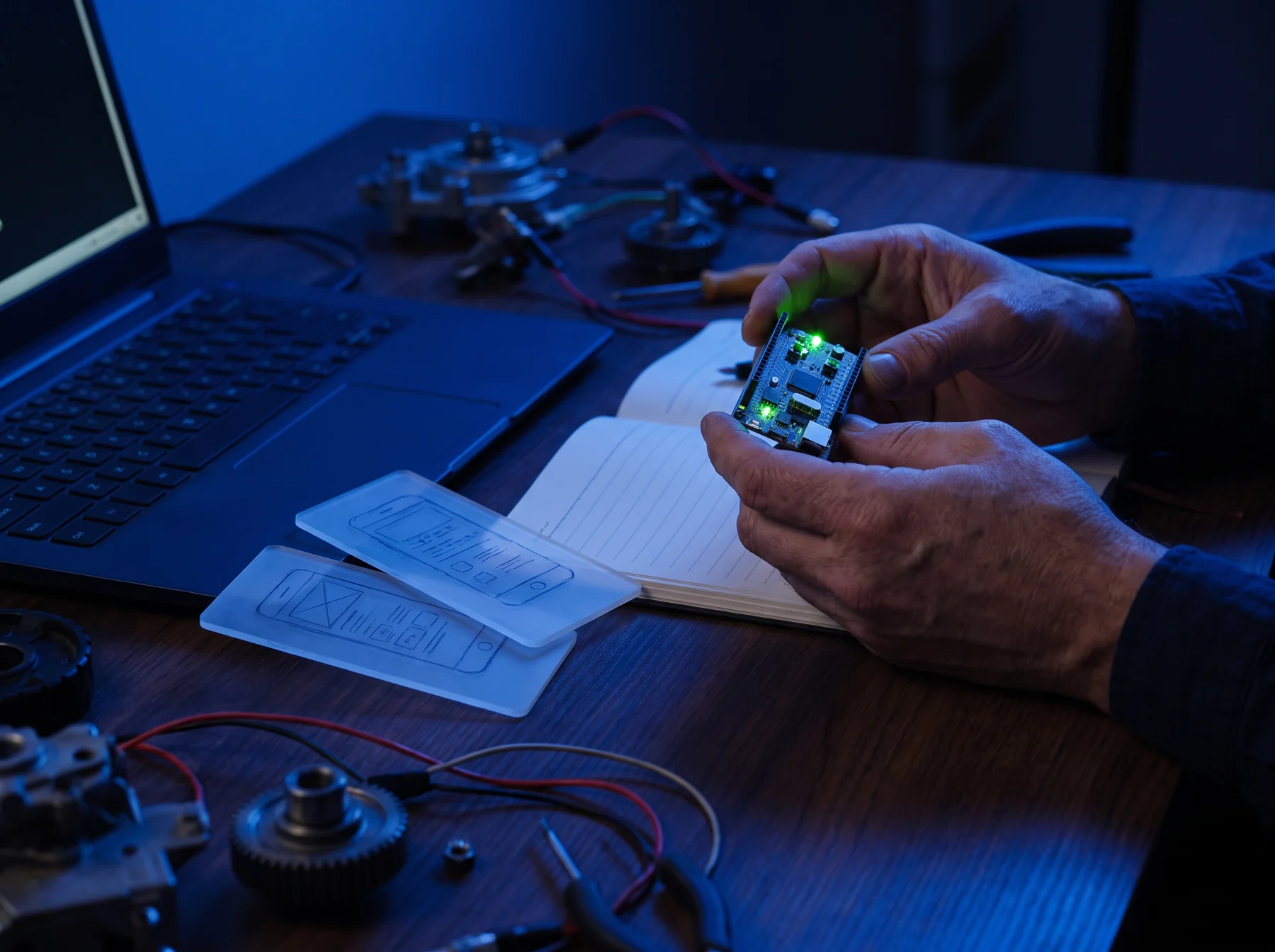
Small responses, loading states, error language, default choices, permissions and return paths can all decide whether a product feels honest when it is used outside a demo.
11 / PRACTICE QUESTIONS
Questions before
the next
commitment.
The answers below describe the public practice. They do not form an engagement, scope or delivery guarantee.
An engagement may include product discovery, interaction and interface implementation, service design, integration, data handling, quality review, deployment preparation and operating notes. The suitable scope depends on the product question and any written agreement. Fadurineko does not claim that every product needs every layer at once or that a particular outcome will follow.
Yes, when the starting point is a bounded feature, condition, service boundary or operational concern. A first conversation can clarify the available context, access assumptions, constraints and whether the question is suited to the practice. It is not a promise to take over, repair, certify or publish an existing system.
Do not send passwords, credentials, production secrets, private repositories, personal records, confidential business information, payment data or other sensitive material through the public form. A concise non-confidential description of the product setting and engineering question is enough to begin an appropriate conversation.
No. This public site does not accept payment, create an order, reserve capacity or make a performance claim. If further work is suitable, scope, responsibilities, timeline, access, fees, acceptance conditions, cancellation and any relevant operational requirements should be described in a separate written agreement.
12 / SYSTEMS NOTE
Bring the part
that needs a
working centre.
Share a short non-confidential account of the product situation and the engineering question you want to clarify. This is an enquiry only and sends nothing from this demonstration website.